How Much Exterior Paint Do I Need?

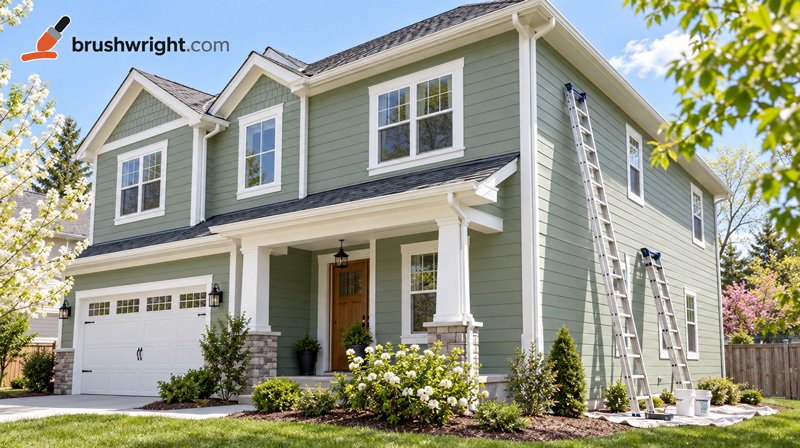
A typical two-story house measuring 50 × 30 ft with wood clapboard or fiber cement siding needs about 23 gallons of exterior paint for two coats, including trim. A one-story ranch about 40 × 28 ft needs about 9 to 10 gallons. Rough cedar, shakes and brick take roughly half again as much, and stucco about twice as much as smooth siding, because textured, porous surfaces soak up far more paint.
To work it out for your house, measure the perimeter and multiply by the wall height, add the triangular gable ends, subtract doors, windows and garage doors, then divide by your siding’s coverage per gallon for each coat. The exterior paint calculator does all of this, in feet or meters.
How much exterior paint for common house sizes
These numbers use the same method as our exterior paint calculator: 9 ft per story, two gable ends under a medium 6/12 roof pitch, typical doors and windows subtracted, two coats, 10% for waste, and 10% more for trim, fascia and soffits.
| House | Area to paint | Vinyl, aluminum or smooth board (350) | Wood clapboard or fiber cement (300) | Rough cedar, shakes or brick (200) | Stucco (150) |
|---|---|---|---|---|---|
| 1-story ranch, 40 × 28 ft, 10 windows, 2 doors, 1 garage door | About 1,170 sq ft | 8.1 gal | 9.5 gal | 14.2 gal | 18.9 gal |
| 1½-story, 36 × 28 ft, 10 windows, 2 doors | About 1,730 sq ft | 12.0 gal | 14.0 gal | 21.0 gal | 28.0 gal |
| 2-story, 50 × 30 ft, 12 windows, 2 doors | About 2,890 sq ft | 19.9 gal | 23.3 gal | 34.9 gal | 46.5 gal |
The numbers in parentheses are the coverage rates, in square feet per gallon per coat, that the calculator uses for each siding type. Your paint’s label gives its own coverage range; if it differs, divide the area by the label figure instead.
How to measure your house
- Measure the perimeter. Walk around the house with a long tape or a measuring wheel and add up the length of every wall. For a simple rectangle, it’s 2 × (length + width).
- Find the wall height. Measure from the bottom of the siding to the roofline. If you can’t reach, count stories: about 9 ft per story is a sensible estimate for most homes, and a 1½-story home is about 13.5 ft to the eaves.
- Multiply perimeter by height for the wall area.
- Add the gable ends. A gable is the triangle of wall under a pitched roof at each end. Its area is half the base times its height. For a common 6/12 roof pitch, the height is a quarter of the base, so each gable is about (width × width) ÷ 8. A 30 ft wide house has gables of about 112 sq ft each.
- Subtract openings. About 20 sq ft per door, 15 per average window and 56 for a single 8 × 7 ft garage door, unless you’re painting the garage door too.
- Add trim. Fascia, soffits, corner boards and window trim add roughly 10% to the paint for a typical house if they’re the same color, or need a separate trim color.
A worked example
Take the 2-story 50 × 30 ft house in the table with wood clapboard siding:
| Step | Calculation | Result |
|---|---|---|
| Wall area | 2 × (50 + 30) × 18 ft | 2,880 sq ft |
| Gable ends | 2 × (30 × 30 ÷ 8) | + 225 sq ft |
| Openings | 2 doors × 20 + 12 windows × 15 | − 220 sq ft |
| Area to paint | 2,885 sq ft | |
| Paint, 2 coats | 2,885 × 2 ÷ 300 × 1.1 waste × 1.1 trim | About 23.3 gallons |
| What to buy | 4 five-gallon pails + 3 gallons, or 5 pails |
Coverage by siding type
| Siding | Coverage we use, per coat | Why |
|---|---|---|
| Vinyl, aluminum, smooth board | About 350 sq ft/gal | Smooth, non-absorbent surface |
| Wood clapboard, fiber cement | About 300 sq ft/gal | Lap edges and some absorption |
| Rough cedar, shakes, brick | About 200 sq ft/gal | Rough, porous and textured |
| Stucco | About 150 sq ft/gal | Very porous and deeply textured |
Porous surfaces drink more paint on the first coat, especially if they’ve never been painted or are weathered, so expect the first coat to use more than the second. Bare wood and new stucco or masonry usually need a primer first, which has its own coverage.
How many coats does exterior paint need?
Two coats is the standard for durable exterior work, and most paint manufacturers recommend two for full film thickness and weather resistance. One coat can be enough when you’re repainting the same or a similar color over sound paint with a high-quality product, but a second coat on the sunny and weather-facing sides of the house greatly extends how long the paint lasts. Big color changes, especially dark to light, may need primer or a third coat.
Do you need exterior primer?
Prime when the surface calls for it, not by default:
- Bare wood, including new boards and spots scraped to bare wood.
- Cedar and redwood, which bleed tannins; use a stain-blocking exterior primer.
- New fiber cement, if the manufacturer specifies a primer or it isn’t factory-primed.
- Masonry and stucco that are new or unpainted.
- Chalky old paint that has been cleaned but still powders, using a primer made for chalky surfaces.
- Repairs and patches.
Our guide to primer explains primer types; outside, always use products labeled for exterior use.
How to buy exterior paint
Exterior jobs are big enough that buying smart saves real money:
- Buy 5-gallon pails for the main color. They usually cost less per gallon, and pouring several cans together in a pail (called boxing) keeps the color perfectly consistent across the house.
- Buy trim colors in gallons, often 1 to 3 gallons for trim, fascia and doors.
- Round up, not down. Running out halfway across a wall leaves a visible line where batches meet. A partly used gallon is cheaper than a second trip.
- In Canada, paint is sold in 3.78 L cans and 18.9 L pails. The calculator shows quantities in liters and Canadian can sizes when switched to metric.
The same houses in metric (Canada)
For wood clapboard or fiber cement siding, two coats with trim, in liters and Canadian container sizes (18.9 L pails and 3.78 L cans):
| House | Paint needed | What to buy |
|---|---|---|
| 1-story ranch, about 12 × 8.5 m | About 36 L | 2 pails |
| 1½-story, about 11 × 8.5 m | About 53 L | 3 pails |
| 2-story, about 15 × 9 m | About 88 L | 4 pails + 4 cans, or 5 pails |
Switch the exterior paint calculator to meters and liters to work out your own house in Canadian sizes.
Painting only part of the house
Not every exterior job is the whole house. To estimate a partial job:
- One side only: measure that wall’s length and height, add its gable if it has one, subtract its openings, and use the same coverage rate.
- Trim only: fascia, soffits, window and door casings and corner boards on a typical house often take 2 to 5 gallons for two coats, depending on the amount of trim and the color change.
- Front door and shutters: a quart or two is usually plenty.
- Garage doors: a single 8 × 7 ft door is about 56 sq ft per side; paneled doors take a bit more.
Common mistakes when estimating exterior paint
- Forgetting the gables. On a two-story house they can add a couple of hundred square feet.
- Using smooth-siding coverage for rough siding. Rough cedar, shakes, brick and stucco can need half again to twice as much paint.
- Planning one coat. Most exterior jobs need two for durability; budget for both even if you hope one will do.
- Ignoring the first-coat soak. Weathered wood and porous masonry absorb far more on the first coat.
- Buying the exact amount. Exterior work almost always uses a little more than the math says. Round up to the next gallon or pail.
- Mixing batches mid-wall. Box your paint in a large pail so the color is consistent across the house.
Keep some paint for touch-ups
Save at least a gallon of the main color and a quart of each trim color when the job is done. Exterior paint takes knocks from ladders, lawn equipment and weather, and touch-ups blend best with the original batch. Seal the cans tightly, label them with the color, brand, sheen and date, and store them indoors where they won’t freeze; water-based paint left in a cold garage or shed over a Canadian or northern US winter can be ruined. Our guide to touching up paint explains how to make repairs disappear.
When to paint the exterior
Most exterior latex paints need the air and the surface above about 10°C (50°F) while you paint and through the next night; some products are formulated for lower temperatures, down to about 2°C (35°F), so check the label. Avoid painting a wall in direct, hot sun, which can make the paint dry too fast and blister. Don’t paint when rain is expected before the paint is dry, or when dew is likely to form on the surface in the evening; the surface should be at least a few degrees warmer than the dew point. In much of Canada and the northern US, that makes late spring through early fall the exterior season, and the best days are dry, mild and overcast.
Our articles on peeling paint and bubbling paint explain what happens when exterior paint goes on in the wrong conditions.
Paint or stain?
For wood siding, stain is an alternative to paint. Semi-transparent stains show the wood grain, soak in rather than forming a film, and are easier to refresh, but they need recoating more often. Solid stains look more like paint but are thinner and soak in. Coverage for stain on rough wood is generally lower than paint on smooth siding, so check the product label and plan for the wood’s texture. For decks and fences, our deck stain calculator and fence stain and paint calculator work out the amounts.
Frequently asked questions
How many gallons of paint does it take to paint a house exterior?
About 20 to 25 gallons for two coats on a typical 2-story house with smooth to medium siding, and about 8 to 10 gallons for a one-story ranch. Rough siding and stucco need much more.
How much does one gallon of exterior paint cover?
Roughly 300 to 350 square feet per coat on smooth or lap siding, and much less on rough wood, brick or stucco. Check your paint’s label for its coverage range.
How do I calculate exterior paint?
Multiply the perimeter by the wall height, add gable ends, subtract doors and windows, multiply by the number of coats, divide by the coverage per gallon, and add about 10% for waste.
Do I need two coats of exterior paint?
Two coats are standard for durability. One may be enough over sound paint in a similar color, but two last longer, especially on sunny walls.
Should I buy 5-gallon buckets of exterior paint?
Yes, for the main color on a whole house. They usually cost less per gallon and keep the color consistent.
What is the best time of year to paint a house exterior?
Late spring through early fall in most of the US and Canada, on dry, mild days above the paint’s minimum temperature, avoiding direct midday sun and evening dew.
Sources
- Amounts: Brushwright exterior paint calculator method: 9 ft per story, gables (width² ÷ 8) for a 6/12 pitch, 20 sq ft per door, 15 per window, 56 per garage door, two coats, 10% waste and 10% for trim.
- Diamond Vogel, Application conditions for exterior latex paint: minimum temperatures, low-temperature formulas to 35°F, and avoiding moisture on the surface.
- Painter price context: NerdWallet, Cost to paint a house in 2026, exterior $1.50–$4 per sq ft.
Estimates only. The coverage printed on your paint can and the product instructions are the numbers to trust.