How Much Paint Do I Need for a Room?

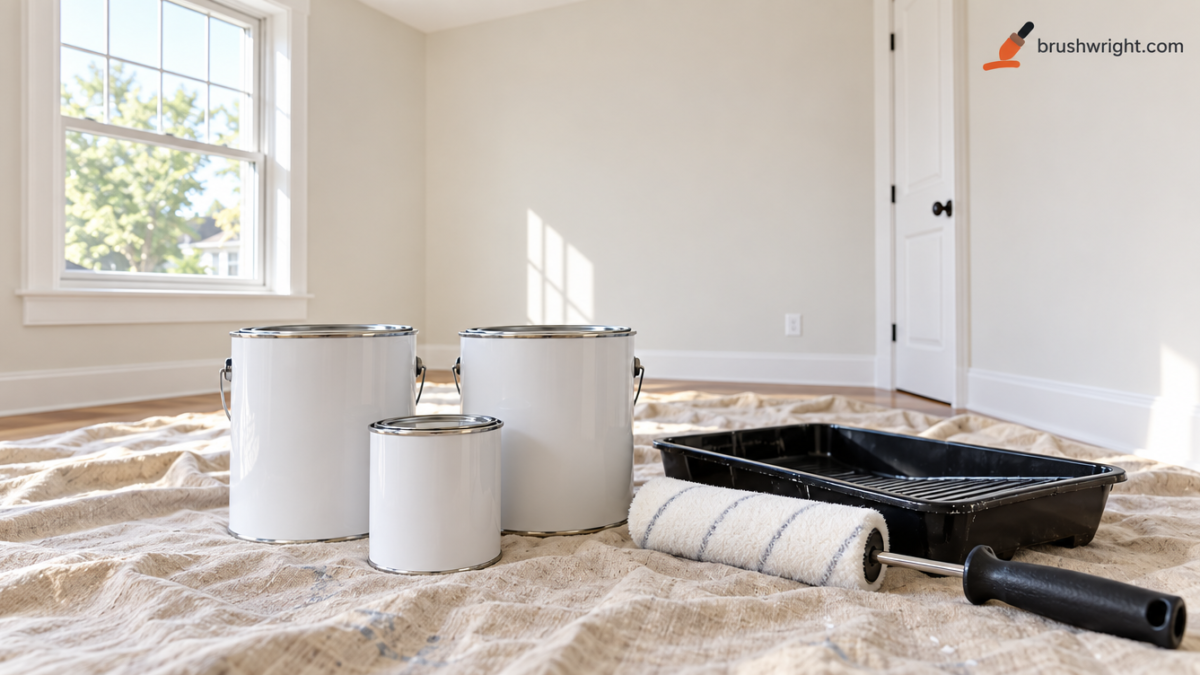
A standard 12 × 12 ft bedroom with 8 ft ceilings needs about 2 gallons of paint (roughly 8 liters) for two coats on the walls. Most interior wall paints cover 250 to 400 square feet per gallon per coat, so plan on one gallon for every 350 square feet of wall you paint, once for each coat.
That’s the number most people need. The rest of this guide is for when your room isn’t a tidy 12 × 12, when you’re covering a dark color, or when you’d rather not stand in the paint aisle at 4 p.m. on a Saturday wondering whether to grab one more can.
If you just want your own number, the paint calculator does all of this for you, in feet and gallons or meters and liters, and tells you which cans to buy.
How much paint do common room sizes need?
We ran six common room sizes through the same math our calculator uses: 8 ft walls, two coats, 350 square feet per gallon, standard door and window deductions, and 10% extra for waste. The last column is what we’d actually carry to the checkout.
| Room (floor size) | Doors / windows | Wall area to paint | Paint for 2 coats | What to buy (US) | In liters |
|---|---|---|---|---|---|
| 10 × 10 ft, small bedroom or office | 1 / 1 | 285 sq ft | 1.8 gal | 2 gallons | 6.8 L |
| 10 × 12 ft, guest room | 1 / 2 | 302 sq ft | 1.9 gal | 2 gallons | 7.2 L |
| 12 × 12 ft, average bedroom | 1 / 2 | 334 sq ft | 2.1 gal | 2 gallons + 1 quart | 7.9 L |
| 12 × 14 ft, primary bedroom | 1 / 2 | 366 sq ft | 2.3 gal | 2 gallons + 2 quarts | 8.7 L |
| 14 × 16 ft, living room | 1 / 3 | 415 sq ft | 2.6 gal | 3 gallons | 9.9 L |
| 16 × 20 ft, large family room | 2 / 3 | 491 sq ft | 3.1 gal | 3 gallons + 1 quart | 11.7 L |
A few things jump out. Room size matters less than people expect: a 10 × 10 office and a 12 × 12 bedroom are only a third of a gallon apart, because the walls grow much more slowly than the floor. And notice the 12 × 14 row. Two quarts often cost nearly as much as a full gallon, so check the shelf price before you buy them; the extra gallon may cost a few dollars more and leaves you with touch-up paint for years.
Ceilings higher than 8 ft change everything in this table. Every extra foot of height adds about an eighth more wall, so a 12 × 12 room with 9 ft ceilings needs closer to 2.4 gallons than 2.1.
How do you calculate how much paint you need?
You need a tape measure, a phone calculator and about five minutes. Measure the walls, not the floor.
- Add up the length of every wall. Walk the room with the tape and write each wall down. In a rectangular room that’s simply twice the length plus twice the width.
- Multiply by the wall height. Measure from the floor to the ceiling; don’t assume 8 ft, since plenty of newer homes have 9 ft walls. The result is your total wall area in square feet.
- Take out what you won’t paint. Behr’s own estimating guide uses about 20 square feet for an average door and 15 for an average window. Large openings like patio doors or a wide archway are worth measuring properly.
- Multiply by coats, divide by coverage. Two coats is the normal plan. Divide by the coverage printed on your can, or use 350 if you haven’t picked a paint yet, then add 10% for the paint that ends up in the tray, the roller and the touch-ups.
Written as one line:
Gallons = ((wall length total × height – doors – windows) × coats) ÷ (coverage per gallon) × 1.1
A 12 × 12 ft bedroom with 8 ft walls, one door and two windows:
If you’d rather not do the arithmetic, the Brushwright paint calculator runs these same steps, shows each line of the math, and turns the answer into a shopping list.
Working in meters
The method is identical. Measure in meters, subtract about 1.9 m² for each door and 1.4 m² for each window, and use a coverage of about 8.6 m² per liter for an average wall. The 12 × 12 ft bedroom above is roughly 3.7 × 3.7 m and needs close to 8 liters for two coats.
Why might you need more paint than the can says?
The coverage on the label is measured on a smooth, sealed surface with the paint applied the way the maker intended. Real walls are rarely that cooperative. Behr, for example, puts its range at 250 to 400 square feet per gallon for a single coat, and where your wall sits in that range is decided by five things.
Texture. Orange peel, knockdown and any hand-troweled finish have more surface than their length and height suggest, and the roller has to push paint into every dip. On textured walls, plan on 300 square feet per gallon rather than 350.
New drywall and fresh patches. Bare drywall paper and joint compound soak up the first coat unevenly, which shows as dull, blotchy patches called flashing. A coat of primer seals the surface so the paint sits on top. Our primer calculator works out how much you need; most primers cover a little less than paint, roughly 200 to 300 square feet per gallon.
A big color change. Going from navy to off-white, or from bright yellow to gray, almost always needs a third coat unless you prime first. A primer tinted towards the new color is usually the cheaper route, because primer costs less than good paint.
Cheap paint. Budget paints tend to carry less pigment, which means less hide per coat. You save on the can and often pay it back with an extra coat. Premium paint and primer products rarely live up to one-coat claims over a different color, but they do tend to sit at the upper end of the coverage range.
How you apply it. A thick roller nap holds more paint than a short one, and spraying loses some paint as overspray. Neither is wrong, but if you spray, add more than the usual 10% buffer.
Do you really need two coats?
In most rooms, yes. One coat can look fine when the new color is close to the old one and the paint is good quality, but a second coat evens out the sheen, fills thin spots you can’t see in the evening, and makes the finish last. Two coats is the honest default, and it’s what every number in this guide assumes. Give the first coat time to dry before you roll the second; the drying and recoat time calculator adjusts the label time for a cold or humid room.
How much paint for the ceiling, trim and doors?
Work these out separately. They’re almost always a different paint, a different sheen, or both, so lumping them into the wall total just means buying the wrong product.
The ceiling. Multiply the length of the room by its width; for a 12 × 12 room that’s 144 square feet. Flat ceiling paint on a smooth ceiling covers close to 400 square feet per gallon, so two coats come to about 0.8 gallons, which in practice means one gallon. Textured ceilings are a different story: popcorn can drink twice as much paint. The ceiling paint calculator has settings for smooth, light texture and popcorn.
Baseboards and casings. Trim takes far less paint than it looks. In our 12 × 12 bedroom, the baseboards, the door casing and two window casings add up to roughly 27 square feet. Two coats of that fits comfortably in a single quart of semi-gloss.
Doors. A standard interior door is about 20 square feet per side. Paint both sides and the edges with two coats and you’ve used most of another quart. So a realistic trim order for one bedroom, door included, is two quarts, or a gallon if you’re doing several rooms in the same trim color.
| Surface in a 12 × 12 ft bedroom | Area | Two coats needs | Buy |
|---|---|---|---|
| Walls | 334 sq ft | 2.1 gal | 2 gallons + 1 quart |
| Smooth ceiling | 144 sq ft | 0.8 gal | 1 gallon |
| Baseboards and casings | about 27 sq ft | under 0.2 gal | 1 quart |
| One door, both sides | about 40 sq ft | 0.2 gal | 1 quart |
What size paint cans should you buy?
Once you have a number, turn it into cans. This is where most leftover paint, and most second trips to the store, come from.
In the US, wall paint comes in quarts, gallons and 5-gallon buckets. Round your total up to the nearest quart, then look at the price tag. Three quarts usually cost more than one gallon, so buy the gallon. Two quarts are often close to a gallon in price as well.
In Canada, the same cans are sold in metric sizes: the “gallon” can holds 3.78 liters and the quart about 946 milliliters. Larger jobs come in 18.9-liter pails. If a Canadian label lists coverage per can rather than per liter, it’s quoting the 3.78-liter can.
For a whole floor or house, the 5-gallon bucket is usually the cheapest per gallon, and it solves a quieter problem too. Two cans of the same color, tinted on different days, can differ very slightly. Painters pour all their cans into one bucket and mix them before starting, a habit called boxing, so the color is identical on every wall. If you buy several gallons, do the same.
Keep the leftovers. A quart of the original color is worth more than you’d think when someone scuffs the hallway a year from now. Hammer the lid on tightly, write the room and the date on top, and store the can where it won’t freeze. The cost to paint a room calculator also works out the paint and supplies bill if you’re still deciding between doing it yourself and hiring out.
Four mistakes that leave you short (or swimming in paint)
- Measuring the floor instead of the walls. Floor area tells you about the ceiling, not the walls. A long, narrow room has more wall than a square room with the same floor area.
- Forgetting the second coat. The single most common reason people run out halfway through a Saturday.
- Trusting the best-case number on the label. “Up to 400 square feet” means on a perfect surface. Use 350 for an average wall and 300 for texture.
- Buying for every room at once without checking the tint. If the store mixes your color over several visits, box the cans together before you start.
Frequently asked questions
How many square feet does a gallon of paint cover?
Most interior wall paints cover 250 to 400 square feet per gallon for one coat. Smooth, previously painted walls sit near the top of that range; textured walls, new drywall and porous surfaces sit near the bottom.
Is one gallon of paint enough for one room?
Usually not for two coats. One gallon covers about 350 square feet once, so it’s enough for two coats only in a small room such as a bathroom or a walk-in closet. An average bedroom needs about 2 gallons.
How much paint do I need for a 12 × 12 room?
About 2.1 gallons for two coats on 8 ft walls with one door and two windows. Buy 2 gallons and 1 quart, or 3 gallons if the quart is nearly the same price. With 9 ft ceilings, plan on about 2.4 gallons.
How much paint do I need in liters?
Allow roughly 1 liter for every 8.6 square meters of wall, per coat. A typical 3.7 × 3.7 m bedroom needs about 8 liters for two coats: two 3.78 L cans and a 946 mL can.
Should I buy extra paint?
Buy about 10% more than the bare calculation, which most calculators, including ours, already include. Keep what’s left for touch-ups, sealed and stored above freezing.
Does a darker color need more paint?
Deep colors often need an extra coat to look even, and painting light over dark almost always does. A tinted primer under the first coat is the usual fix.
Sources
- Behr, How much paint do I need?: coverage of 250–400 sq ft per gallon per coat; average door 20 sq ft and window 15 sq ft.
- NerdWallet, Cost to paint a house in 2026: 350–400 sq ft per gallon for interior paint and 200–300 sq ft per gallon for primer, citing Lowe’s.
- Room-size table: Brushwright calculation, 8 ft walls, two coats, 350 sq ft per gallon, plus 10%.
Estimates only. The coverage printed on your paint can and the product instructions are the numbers to trust.