How to Paint a Room

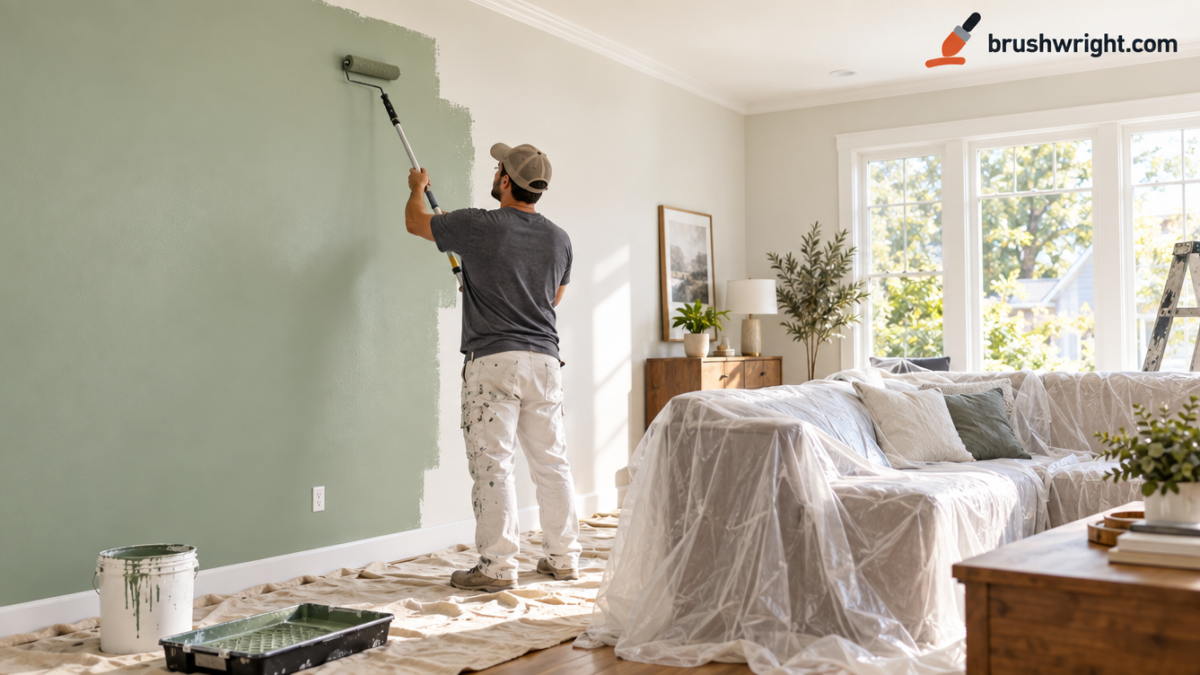
To paint a room, clear and protect it, wash and repair the walls, prime any patches or bare drywall, cut in along the ceiling, corners and trim with a brush, then roll the walls in sections while the cut-in edge is still wet. Let the first coat dry, roll a second, and pull off any tape before the paint fully hardens.
That’s the whole job in two sentences. What separates a finish you’re proud of from one that shows every roller pass is in the details below, most of which nobody tells first-timers until they’ve already made the mistake.
What do you need to paint a room?
Before the steps, get the shopping right. Running out of something halfway through is how a one-day job turns into two.
- Paint, enough for two coats. A 12 × 12 ft bedroom takes about 2 gallons; our guide on how much paint you need for a room has a table for six room sizes, or use the paint calculator.
- Primer, only if you have new drywall, big patches, stains, or a dark-to-light change.
- A 2 to 2½ inch angled sash brush for cutting in. A good one is worth the extra few dollars; cheap brushes shed bristles into your wall.
- A 9 inch roller frame, two roller covers and a tray. A 3/8 inch nap suits most smooth or lightly textured walls.
- An extension pole. Even for 8 ft walls. It saves your shoulders and gives you more even pressure.
- Drop cloths, painter’s tape, spackle, a putty knife, fine sandpaper, a sponge and a bucket.
Step 1: Clear the room and protect the floor
Move small furniture out and push big pieces to the middle of the room under a plastic sheet. Take down pictures, curtain rods and shelves, and put the screws in a labeled bag; you’ll thank yourself later. Unscrew outlet and switch covers rather than painting around them. Lay canvas drop cloths along the walls. Canvas is worth it over plastic on the floor: it doesn’t slide under your feet and it soaks up drips instead of letting you track them across the house.
Step 2: Wash and repair the walls
This is the step almost everyone skips, and it’s the one that decides whether the paint lasts. Walls collect dust, cooking grease and fingerprints, and paint grips that film instead of the wall. Wipe them down with a sponge and warm water with a little dish soap, paying attention to the areas around switches, the kitchen side of a wall and the strip above baseboards. Rinse with clean water and let them dry.
Then fill nail holes and dents with spackle, let it dry, and sand it flush with fine sandpaper. Run your hand over each repair. If you can feel it, you’ll see it once the paint goes on, especially in a sheen like eggshell or satin.
Step 3: Tape, if you need to
Tape is optional, and many experienced painters barely use it. If your hand is steady, a good angled brush will give a cleaner line than tape. If you’d rather tape, use a quality painter’s tape, press the edge down firmly with a putty knife, and tape only the edges you’re nervous about, usually the ceiling line and the top of the baseboards.
Step 4: Prime the spots that need it
Prime every spackle patch, or it will show through as a dull spot called flashing. Prime the whole wall if it’s new drywall, if there are water or smoke stains, or if you’re covering a dark color with a light one. Most walls that were painted before and are just getting a refresh in a similar color don’t need primer at all. If you’re priming whole walls, the primer calculator tells you how much to buy.
Step 5: Cut in the edges with a brush
Cutting in means brushing a band of paint about 2 to 3 inches wide wherever the roller can’t reach cleanly: along the ceiling, down each corner, around the door and window casings, and above the baseboards. Paint the ceiling first if you’re doing it, then the walls, then the trim.
Dip only the bottom third of the brush, tap it against the inside of the can, and start a little away from the edge. Then sweep the brush slowly towards the line and along it, letting the bristles fan out to the edge. Speed comes later; a slow, steady stroke is what gives a straight line.
The pro habit worth copying is to cut in one wall at a time, then roll that wall straight away. Paint that’s still wet blends into the rolled area. Cut in the whole room first and the brushed band dries, and you’ll see a picture-frame outline around every wall when the light hits it.
Step 6: Roll the walls
Load the roller in the tray until it’s full but not dripping, then roll it on the ridges of the tray to even it out. Start about a foot from a corner and roll a large W or M shape roughly 3 ft by 3 ft, then fill it in with straight, overlapping vertical passes without lifting the roller off the wall. Move on to the next section and roll back into the edge of the last one while it’s still wet.
That last idea has a name, keeping a wet edge, and it’s the single most important thing in this guide. Lap marks, those stripes of darker or shinier paint you see on badly painted walls, happen when fresh paint goes over paint that has started to dry. Work top to bottom, one full wall at a time, and don’t stop in the middle of a wall to answer the phone.
Two more habits help. Let the roller do the work; pressing hard squeezes paint out at the ends and leaves ridges. And when the roller starts to sound sticky and drag, reload it rather than stretching the paint thin.
Step 7: Let it dry, then roll a second coat
The first coat almost always looks patchy. That’s normal, not a sign you did something wrong. Wait the recoat time on the can, about four hours for most latex wall paints at room temperature, and longer if the room is cold or humid; the drying and recoat time calculator adjusts for that. Then repeat steps 5 and 6. Between coats, wrap your brush and roller tightly in plastic wrap or a bag and they’ll stay usable for hours without washing.
Step 8: Remove tape, paint trim and clean up
Pull tape off once the final coat is dry to the touch but before it fully hardens, peeling it back slowly at a sharp angle. If the paint has already set and starts lifting with the tape, score the edge lightly with a utility knife first.
Trim and doors come last, usually in a semi-gloss that stands up to knocks and cleaning. Then put the outlet covers back, rehang the curtains, and leave the room to cure. Latex paint feels dry within hours but takes a couple of weeks to reach full hardness, so go easy on scrubbing and don’t push furniture tight against the walls for a few days.
How long does it take to paint a room?
For a first-timer, an average bedroom is a full day of work spread over a day and a half. Roughly: an hour or two to clear and protect the room, an hour or two to wash and patch, about two hours for each coat of cutting in and rolling, and four hours of drying between coats. Prep is the part people underestimate. If the walls need a lot of patching, the spackle needs time to dry before you can sand and prime, which can push the painting to the next day.
Five mistakes that show in the finished wall
- Skipping the wash. Paint over grease peels and looks blotchy around switches and in kitchens.
- Cutting in the whole room first. The brushed edges dry and frame every wall with a visible band.
- Rolling over half-dry paint. That’s what causes lap marks. Finish a wall in one go.
- Overloading the brush. Too much paint on the bristles floods into the ceiling line and the corners.
- Rushing the second coat. Recoating early drags the first coat around and leaves a rough, uneven sheen.
Frequently asked questions
Do you cut in or roll first?
Cut in first, one wall at a time, then roll that wall while the cut-in band is still wet. The two areas blend and you avoid a visible frame around the wall.
Should you paint the ceiling or the walls first?
The ceiling. Drips and roller spatter fall onto the walls you haven’t painted yet, and you can cut the wall color neatly up to the ceiling afterwards.
Do you need to prime before painting a room?
Only in some cases: new drywall, patches, stains, glossy surfaces and big dark-to-light color changes. A wall in good condition being repainted in a similar color usually doesn’t need primer.
How many coats of paint does a room need?
Two, in almost every case. One coat rarely gives an even color and sheen, even with paint-and-primer products.
Can I paint a room in one day?
Yes, if the prep is done the day before and the paint dries quickly enough to recoat in a few hours. Doing the cleaning and patching the evening before is the easiest way to make it a one-day job.
Do I need to wash walls before painting?
Yes. A quick wipe with mild soapy water, then a rinse, removes the dust and grease that stop paint from bonding. Let the walls dry fully before you start.
Sources
- Behr, How much paint do I need?: coverage per gallon and two-coat guidance.
- Recoat and cure times: typical label guidance for interior latex paint; always follow the instructions on your can.
Estimates only. The coverage printed on your paint can and the product instructions are the numbers to trust.