What Is LRV in Paint?

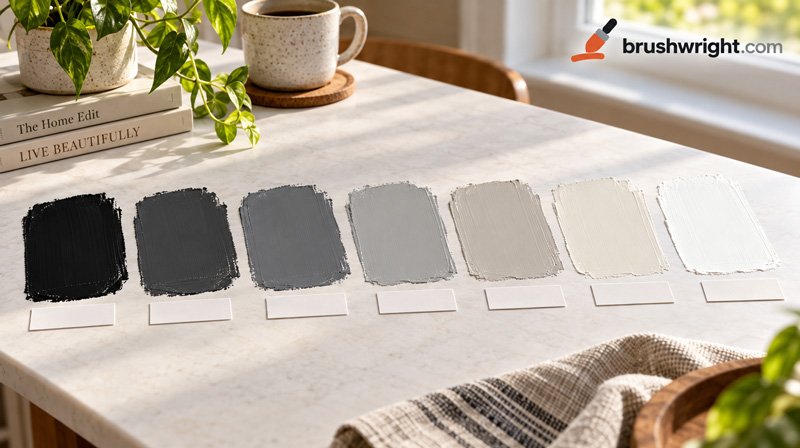
LRV, or light reflectance value, is a number from 0 to 100 that tells you how much visible light a paint color reflects: 0 is a theoretical perfect black that absorbs everything, and 100 is a perfect white that reflects everything. Real paints range from about 2 to 5 for the deepest blacks up to the low 90s for the brightest whites. The higher the LRV, the lighter and brighter a color looks on the wall and the more it helps light a room.
LRV is one of the most useful numbers on a paint chip, because it cuts through the way colors are named and lit in stores. Two colors called “soft gray” can be twenty points apart, and that difference shows clearly on four walls.
What LRV actually measures
LRV measures the share of visible light a surface reflects, weighted the way the human eye perceives brightness. Our eyes are most sensitive to green and yellow light and least sensitive to blue, so a green and a blue that look equally strong in color can have quite different LRVs. That’s what makes LRV useful: it tracks how light a color will feel to you, not how much pigment is in the can.
LRV doesn’t describe hue, warmth or undertone. A warm beige and a cool gray can share the same LRV and look equally light, but very different in character. Our guide to paint undertones covers that side.
Why a middle gray is darker than you think
Brightness on the LRV scale isn’t linear the way color pickers suggest. On a screen, #808080 looks like the exact middle between black and white, but its estimated LRV is only about 22: it reflects roughly a fifth of the light that falls on it. Here’s how some common colors compare, estimated from their hex codes with the same method our LRV checker uses:
| Color | Hex | Estimated LRV |
|---|---|---|
| Pure white (screen) | #FFFFFF | 100 |
| Warm off-white | #F7F4EF | About 91 |
| Light greige | #E8E4DC | About 78 |
| Light gray | #D3D3D3 | About 65 |
| Mid-light gray | #B0B0B0 | About 43 |
| Soft sage | #9DB3A6 | About 42 |
| Middle gray | #808080 | About 22 |
| Slate | #5B6770 | About 13 |
| Navy | #2F3E4E | About 5 |
| Near black | #1C1C1C | About 1 |
The practical lesson: colors that look “medium” on a chip or a screen often read darker on a wall than people expect. If you want a room that feels light, look for an LRV of about 60 or higher, not something that merely looks mid-toned.
These are estimates from screen colors. Paint manufacturers measure LRV on the physical paint with an instrument, and their published number is the one to trust for a specific color.
What LRV means in a real room
| LRV range | How it reads on walls | Good for |
|---|---|---|
| 80 to 94 | Whites and very pale colors; bright and airy | Ceilings, small rooms, dark rooms, north-facing rooms, trim |
| 60 to 80 | Light colors; clearly colored but still bright | Most living spaces and bedrooms |
| 40 to 60 | Mid-tones; color is obvious, rooms feel cozier | Rooms with good daylight, dining rooms, accents |
| 20 to 40 | Deep mid-tones; noticeably darker in low light | Accent walls, bright south-facing rooms |
| Below 20 | Dark and dramatic | Accent walls, powder rooms, doors, cabinetry |
Light affects the reading. A color with an LRV of 55 can feel bright in a sunny, south-facing room and gloomy in a north-facing basement bedroom. Our guide to choosing a paint color explains how window direction changes colors.
How to use LRV when choosing paint
For small or dark rooms, choose an LRV of 65 or higher on the walls and a white of 85 or higher on the ceiling. More reflected light makes the room feel larger and brighter.
For an accent wall, look for an LRV clearly lower than the main walls, often 20 to 30 points or more, so the accent reads as intentional. Our accent wall guide covers choosing the color.
For trim and walls, some contrast in LRV makes trim look crisp. If you want trim and walls to blend, keep their LRVs within a few points.
For ceilings, a high-LRV flat white bounces light back into the room, which is why most ceilings are white even when the walls aren’t.
For comparing two whites or two grays, LRV tells you which is lighter instantly, even when names and store lighting make them look similar.
LRV room by room
Living room. With good daylight, an LRV of 55 to 75 gives color without gloom. In a north-facing or tree-shaded living room, stay above 65 and lean warm.
Bedroom. Bedrooms can go a little lower, 45 to 70, because a cozier feel suits them and they’re used mostly in the evening under lamps. Very deep colors work well behind the headboard as an accent.
Kitchen. Kitchens benefit from brightness for cooking and cleaning; 65 and above is a common choice on walls, especially if the cabinets are a mid or dark tone.
Bathroom. Small bathrooms with little or no window feel larger at 70 and above. Powder rooms are the exception, where a deep, low-LRV color creates a dramatic, intimate space.
Hallways and stairwells. These usually have the least natural light in the house. An LRV of 70 or higher keeps them from feeling like tunnels.
Basements. Basements are lit mainly by artificial light; light colors of 70 and above make the biggest difference here. Our guide to painting basement walls covers the rest.
Home office. A mid-to-light color around 50 to 70 reduces glare compared with bright white while keeping the room bright enough to work.
Common LRV mistakes
- Trusting the chip in store lighting. Stores are brightly lit; your hallway isn’t. Check the LRV number rather than your impression of the chip.
- Choosing “medium” colors for a dark room. A color that looks medium usually has an LRV in the 30s or 40s and can feel heavy in low light.
- Ignoring the ceiling. A dark or off-color ceiling lowers the light in the whole room. Most rooms benefit from a ceiling white in the 80s or 90s.
- Pairing trim and walls with nearly identical LRVs by accident. If you want contrast, make it clear; if you want them to blend, choose it deliberately.
- Forgetting the floor. Dark floors absorb light too. A room with a dark floor and mid-tone walls can feel much darker than either alone.
Using LRV to make a whole house flow
Rooms that open onto each other feel connected when their LRVs are in a similar range, even if the colors differ. A practical approach is to keep the main living areas and hallways within about 10 to 15 LRV points of each other, use one ceiling white throughout, and save the big LRV jumps for rooms with doors, such as a deep-colored dining room, office or powder room. That way the eye moves through the house smoothly, and the darker rooms feel like deliberate destinations.
LRV and how many coats you’ll need
LRV also hints at how hard a color change will be. Covering a low-LRV color with a high-LRV one, such as navy (about 5) with an off-white (about 90), is a big jump in brightness, and it usually needs a gray-tinted primer plus two coats. Our guide to painting over dark walls explains the method. Going the other way, from a light color to a very deep one, usually needs a tinted primer or a third coat, because deep paints hide less per coat. Our article on how many coats you need covers both directions.
LRV, contrast and accessibility
Designers also use LRV to create visual contrast for people with low vision, for example between walls and floors, doors and walls, or stair edges and treads. UK accessibility guidance, often cited by designers in North America too, recommends a difference of at least 30 LRV points between adjacent surfaces that need to be told apart. In a home, that can mean a door noticeably lighter or darker than its wall, or a contrasting color on stair nosings. It’s a useful rule for homes where someone has limited vision, and for aging in place.
LRV outdoors: color and heat
On exterior walls, doors and siding, LRV is tied to heat. Dark, low-LRV colors absorb more sunlight and get hotter, which can stress some materials. Some vinyl siding and some fiberglass and vinyl door makers specify minimum LRVs or approved colors for that reason, so check the manufacturer’s guidance before painting them a dark color. On wood and masonry, dark colors are generally fine but may fade faster in strong sun.
How to find a color’s LRV
- Check the chip. Many manufacturers print LRV on the back of paint chips or in small type on fan decks.
- Check the manufacturer’s website. Most list LRV on each color’s page, usually under technical or color details.
- Ask the paint store. Staff can look it up in the brand’s system.
- Estimate it from a hex code. If all you have is a digital color, the color LRV checker estimates LRV and whether the color leans warm or cool. Treat the result as a guide, because screens and lighting vary.
Does sheen change LRV?
LRV is defined for the color, and published values don’t change with sheen. In a room, glossier sheens can make a color look a little lighter in places because they reflect highlights from windows and lamps, while flat and matte finishes look slightly deeper and softer. The effect is small compared with the LRV of the color itself. Our guide to paint sheens explains more.
Frequently asked questions
What is a good LRV for walls?
For most living spaces and bedrooms, about 60 to 80 gives a light, comfortable room. Small or dark rooms benefit from 70 or higher; rooms with lots of daylight can carry lower values.
What LRV is a white paint?
Most paint whites have LRVs in the high 80s to low 90s. Off-whites and creamy whites are often in the 80s.
Is a higher LRV better?
Not always. Higher LRV means lighter and brighter, which helps small and dark rooms, but deeper colors with lower LRVs create cozy, dramatic spaces. It depends on the room and the effect you want.
Can LRV tell me if a color is warm or cool?
No. LRV only measures lightness. Warmth and undertone are separate; compare chips side by side or use a tool that also estimates temperature.
Why does my paint look darker on the wall than on the chip?
A large area of color, less light than in the store, and shadows in corners all make colors read darker. LRV helps predict this: aim a little higher than you think if you want a light room.
What is the LRV of black paint?
The deepest black paints are typically in the low single digits, often around 2 to 5.
Sources
- LRV estimates: Brushwright calculation, relative luminance from sRGB (IEC 61966-2-1), the method used in our LRV checker; published manufacturer LRVs take precedence for specific paints.
- Accessibility contrast: UK guidance BS 8300 on luminance contrast between adjacent surfaces.
Estimates only. The coverage printed on your paint can and the product instructions are the numbers to trust.